
Places we love just outside Barcelona

Sometimes members ask me about this..so I’ve compiled a list of the most beautiful places outside of Barcelona, you will get many recommendations but I assure you these are the top 4 places you must see if you’re a repeat visitor to our beautiful city, or maybe you are on an extended stay and want to explore more of what Catalonia has to offer. I will discover them to you from the closest to the farthest.
1. Castelldefels Beach and Gavá Mar – 20 km from Barcelona Center
Castelldefels is probably the coastal town I have most recommended, it’s just past the Airport and even worth getting a hotel to stay there for several days. Even in congress seasons like mobile Congress I have recommended some of our members to locate there (or in Gava Mar) for a more vacation feel in their off hours to escape the city. It’s to the Hospitalet side of Barcelona so travelling to and from the fairs is pretty fast (usually around 15 minutes) and the airport is only 10 minutes away. The beach here is long, wide and much more tranquil. On windy days you’ll see kitesurfers creating a photo perfect sea horizon. It’s a place to enjoy good sea-food at the foot of the sandy beach, or discovering only those places locals know such as the Playa Grande Beach Club and Boutique Hotel or La Toja Restaurant. If you’re a wine lover you’ll also love the food and drink at the Torreon Restaurant in Gava. These are the hidden secret gems of good food only insiders know about, and if you’re looking for a genuine Spanish paella far away from touristy places you need to check out a little place named El Avión (Castelldefels).
Adding extra to your experience, a glass of wine or a cold beer (very Spanish) you’ll see the line of the coast, little planes in the sky approaching the airport and locals enjoying the “joie de vivre”. You’re starting to get the lifestyle vibe of living on the mediterranean here.. towards the end of the day, there’s this soft orange/pink light over the Garraf hills that makes even the apartment blocks look romantic.
2. Garraf – 30 km from Barcelona Center
Keep following that same coast and things stop being flat and easy. The train car suddenly darkens and brightens as it jumps in and out of tunnels, cliffs right next to your window. That’s Garraf. Half the time, someone in the carriage will pull out their phone to take the same photo of the same curve in the track. You can’t help it; the rock drops almost straight into the sea and you realise how quickly the city turned into coastline drama.
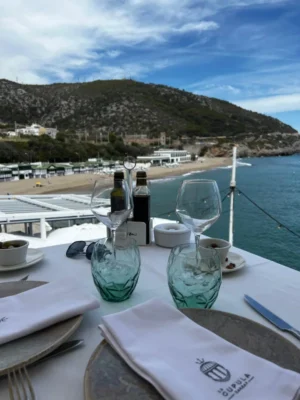
Garraf village itself is tiny. If you go by train or by car, you’ll feel suspended between rock and water. There’s that little row of green-and-white wooden bath houses on the sand that everyone photographs at least once. The beach is smaller, quieter, with that strange mix of sunbathers, old men who clearly come every single day, and the odd group of friends who misjudged the timetable and now have an hour to “kill” by doing absolutely nothing. It’s easy to just sit and stare at the water here, enjoy it while you’re here. Insider tip: Wine and dine with impressive views and an elite service at La Cupula Restaurant.
If you’re a Soho house member you’ll be pleasantly surprised by the Little Beach House by Soho (open usually from March onwards) that offers a members only, curated, boutique hotel only for those who can and know..
3. Sitges – 39 km from Barcelona Center
Following further down the same coastal line you’ll find Sitges, which is a whole different thing, somewhere between ibizean white architecture and a splash of mediterranean soul. It’s hard to describe..you must see it and more importantly feel it.
The beach side promenade feels polished and photo ready – just stay in the moment and you’ll feel what the mediterranean life is all about, slow down your pace and indulge in the surroundings. The church on the little headland at the end of the beachside is in half the photos anyone ever takes here – it’s almost impossible not to point your camera at it as the sun drops. But don’t keep it at that, come closer, it’s even more magical when you approach and discover it’s inner beauty.
My favourite things about Sitges is just discovering the backstreets. White façades, blue shutters, pink and purple flowers, bits of modernist architecture wedged between simpler houses. You pass bars that look like they’ve been serving the same exact vermut for decades, and newer places making “artisanal” everything.
Sitges has a reputation for its nightlife and its Pride, and yes, it’s lively, loud, unapologetically queer-friendly. But go on a random Tuesday outside of high season and it’s almost shy. Old men reading the paper on benches, teachers walking home from school, washing hanging out above narrow streets. It’s not just a postcard.
4. Cadaqués – 170 km from Barcelona (but totally worth it!)
If you move north from Barcelona, things change again. The Costa Brava feels farther in every sense: the light is sharper, the coast more jagged, and the pace different. Cadaqués is one of those places people either romanticise like crazy or dismiss as “too discovered”. Both are a bit right. Did you know Estrella Damm actually filmed their “Mediterranean Lifestyle” commercials here? Yes, it’s that special feel.
The road there twists like it’s trying to shake you off. On summer Sundays it can be a slow procession of cars, all paying the price for wanting something beautiful at the same time. But once you drop into the village and see that sweep of white houses around the bay, you get why people put up with it.
Cadaqués isn’t a checklist town; it’s more about drifting. You wander past white walls where the paint is never completely fresh, blue doors with peeling edges, little churches that look simple from the outside and more ornate within. Down by the water, the stones on the beach are hell on bare feet at first, then kind of addictive. The sea is colder here, clearer too. People swim slowly, no one in a rush to get out.
There’s a reason artists fell for this place. The light in the late afternoon does that thing where everything looks like a painting — the boats, the roofs, even the laundry. You might walk around and suddenly realise you’ve seen this view before in some Dalí print without knowing it. If you go over to Portlligat and visit his house, it’s strange and playful and absurd in that very him way; it also makes you understand that he wasn’t crazy to choose this exact corner of the Mediterranean. Cap de Creus, just beyond, feels almost lunar in parts. If you’re up for a hike, we’d recommend a sunset or sunrise from here.
More of Catalonia to discover
Ask someone from Barcelona and they’ll throw in a few more without thinking: a day in Tarragona for Roman stones and a beach right under the amphitheatre; an afternoon in Girona wandering the old walls and pretending you might actually move there one day; a wine-soaked weekend in Penedès where you get lost between vineyards and cava cellars and end up buying bottles you swear you’ll “save for a special occasion”.
The thing about living here is that these places stop being “destinations” and become moods. Castelldefels is “I need the sea but not the chaos”. Garraf is “let’s disappear for half a day”. Sitges is “I feel sociable again”. Cadaqués is “I want to feel far away without leaving Catalonia”. You don’t analyse it; you just check the trains, or throw a bag in the car, and go.
When you ride the same road in reverse you’ll suddenly notice the pattern picturesque towns to cliffs, cliffs to suburbs, suburbs to city. The signal bars on your phone climb back up, and that first breath of slightly heavier, slightly more polluted air hits you at Passeig de Gràcia. You step off, shake the sand out of your shoes as best you can, and already start planning the next time you’ll be back here because there’s never enough.